

Hair restoration has become one of the most effective and popular aesthetic procedures worldwide. When considering hair transplantation, one of the primary concerns for patients revolves around the natural look of the final outcome and any visible traces left behind. A common question naturally arises: what kind of scars remain after a hair transplant? Because hair restoration involves precision surgical techniques, understanding how the scalp heals is essential for setting realistic expectations.
In this comprehensive guide, we examine how scalp tissues respond to treatment, how post-surgical scars develop, and why modern hair restoration techniques ensure these marks remain undetectable for both men and women.
1. Why Do Scars Form After Hair Restoration?
It is essential to understand that hair transplantation is a surgical procedure. Any intervention that involves micro-incisions on the scalp initiates a natural physiological healing response. As the skin repairs itself, collagen tissue forms to heal the micro-wounds, resulting in minimal scarring.
The crucial factor is visibility. Advanced surgical protocols and refined micro-tools minimize tissue trauma, ensuring that scarring remains imperceptible to the casual observer.
The procedure involves two primary scalp zones:
- The Donor Area: The healthy area (typically the back or sides of the head) where hair follicles are extracted.
- The Recipient Area: The targeted area where healthy grafts are implanted to restore density.
2. The Recipient Site: Natural Hair Growth and Seamless Blending
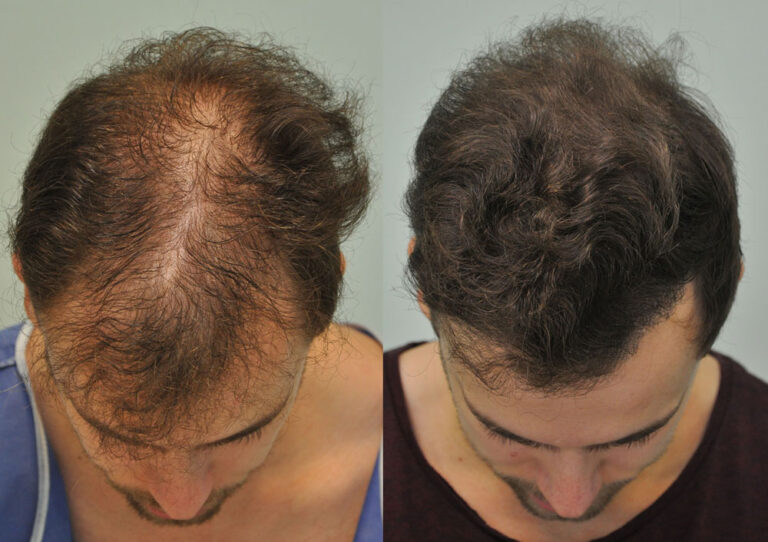
The goal of hair restoration is to achieve dense, natural-looking coverage. Patients frequently worry that scarring in the recipient area might affect overall hair aesthetics. By two weeks post-op, initial redness subsides significantly, and skin texture rapidly returns to normal.
However, in the recipient site, post-procedural marks are undetectable due to two key factors:
- Natural Growth Direction: Surgeons precisely mirror the natural angle and exit direction of existing hair strands. As new hair grows, it naturally conceals the microscopic implantation entry points.
- Microscopic Precision: Ultrafine blades and custom implantation instruments create microscopic recipient channels, leaving negligible scar tissue after full healing.
3. The Donor Site: Understanding Microscopic Hypopigmented Dots
With modern individual graft extraction techniques, tiny, pinpoint pale scars remain where follicular units were removed. These marks are:
- Non-linear (unlike traditional strip surgery scars).
- Extremely small, typically under 1mm in size.
This pinpoint healing pattern makes modern extraction ideal for short hairstyles. Patients can confidently wear short haircuts without revealing signs of a prior surgical procedure.
4. Hair Transplants for Men: Short Hairstyles and Concealed Scars
Scarring concerns are particularly prominent among male patients who prefer close-cropped or faded hairstyles along the sides and back of the head.
Modern follicular extraction addresses this concern directly. Because extraction sites are small and scattered, contrast between hair density and skin tone remains balanced. Even if future sessions are required as androgenetic alopecia progresses, proper donor management keeps the donor zone looking natural and healthy.
5. Hair Transplants for Women: Aesthetic Refinements and Discreteness
Female hair restoration often focuses on lowering the hairline or increasing overall density. For women, discreet scarring is paramount. Fortunately, longer surrounding hair coupled with excellent scalp vascularity allows complete concealment of procedural marks.
As new growth matures along the recipient zone, full coverage is re-established seamlessly, restoring both hair density and personal confidence.

6. What to Expect 1 Month After a Hair Transplant
The one-month post-operative mark is a key milestone in the healing timeline. Here is what patients typically observe at 30 days:
Fully Healed Micro-Incisions: Surgical entry sites are fully closed.
Settled Donor Region: Microscopic extraction sites are no longer tender, and surrounding hair regrowth covers the donor zone.
Recipient Site Progress: Post-procedural erythema (redness) has significantly diminished. Temporary shock loss may occur (a normal phase where hair shafts shed while roots remain secure) making refined micro-incision techniques essential for a natural transition.
At this stage, the scalp appears healthy, paving the way for new hair growth over the coming months.
7. FUE vs. FUT: Comparing Surgical Techniques and Scarring
Selecting the appropriate surgical methodology directly influences scarring patterns and recovery time. While traditional strip harvesting (FUT) remains suitable in specific clinical scenarios, modern Follicular Unit Excision (FUE) is widely preferred for minimal scarring and versatile styling flexibility. The comparison below highlights the distinctions between both options.
| Hair Transplant Technique | Surgical Method | Scar Pattern | Ideal Candidate |
|---|---|---|---|
Individual follicular unit grafts are extracted using micro-punches (manual or motorized). Minimally invasive with faster healing. |
Tiny, scattered dot-like scars in the donor site. Imperceptible even with short hairstyles. |
Ideal for most patients, particularly those who prefer short hair or seek a faster, less invasive recovery. | |
A narrow strip of scalp tissue is harvested from the donor site, dissected under microscopes, and closed with sutures. |
A thin linear scar across the donor area. Concealed by longer hair, but may be visible with short cuts. |
Suitable for patients requiring extensive graft counts who maintain longer hairstyles and prefer not to shave the donor area. |
8. The Impact of Multiple Hair Restoration Sessions on Scarring
Patients frequently ask whether undergoing subsequent procedures increases noticeable scarring or depletes donor hair over time.
Through strategic donor management, experienced surgeons evenly harvest grafts across safe zones. Proper donor mapping prevents patchy thinning or cumulative visible scarring, keeping the scalp healthy across multiple sessions.
At Sikos Clinic, hair restoration combines medical expertise with artistic precision to achieve natural-looking results. While minor scarring can be a normal part of the healing process, advanced techniques help keep scars minimal, discreet, and concealed by surrounding hair.
The goal is to restore hair density while preserving styling versatility and confidence. At Sikos Clinic, our experienced team focuses on personalized treatment planning, careful graft placement, and natural-looking results.
Ready to take the next step? Book your consultation at Sikos Clinic to discuss your hair restoration goals and explore the most suitable treatment options for you.
Frequently Asked Questions About Hair Transplant Scars
Will I have visible scars after a hair transplant?
Because hair transplantation involves surgical micro-incisions, minor scar tissue is expected. However, modern FUE procedures leave microscopic, dot-like scars that blend naturally into the scalp, making them almost invisible.
Will scars show if I wear a short haircut after FUE?
The punctate scars that form during modern FUE hair transplantation are typically very difficult to notice. They can ensure a natural overall appearance, even with very short hair. The technique used to extract the grafts (hair follicle units) plays a key role in this. With an experienced specialist, the traces of the procedure can be kept to a minimum. At Sikos Clinic we place special emphasis on professional execution and natural-looking results.
Where do scars form during a hair transplant procedure?
Scars occur in both the donor area (where hair grafts are harvested) and the recipient area (where grafts are placed). Recipient micro-incisions heal completely beneath growing hair, while donor sites heal as small pinpoint marks.
Can I still wear short hair if I need more than one hair transplant procedure?
Yes. Proper donor management allows surgeons to perform multiple sessions without causing over-harvesting or noticeable scarring, preserving your ability to wear short hairstyles comfortably.
Does choice of surgical technique impact scar visibility?
Yes. FUE produces scattered micro-dot scars, whereas FUT leaves a thin linear scar. Selecting an experienced surgical team ensures optimal healing regardless of the technique used.